
How Much Does a Complete Golf Simulator Really Cost?
The launch monitor is one line item. Here is the complete list of what a working simulator actually requires — so you can budget the project, not the gadget.
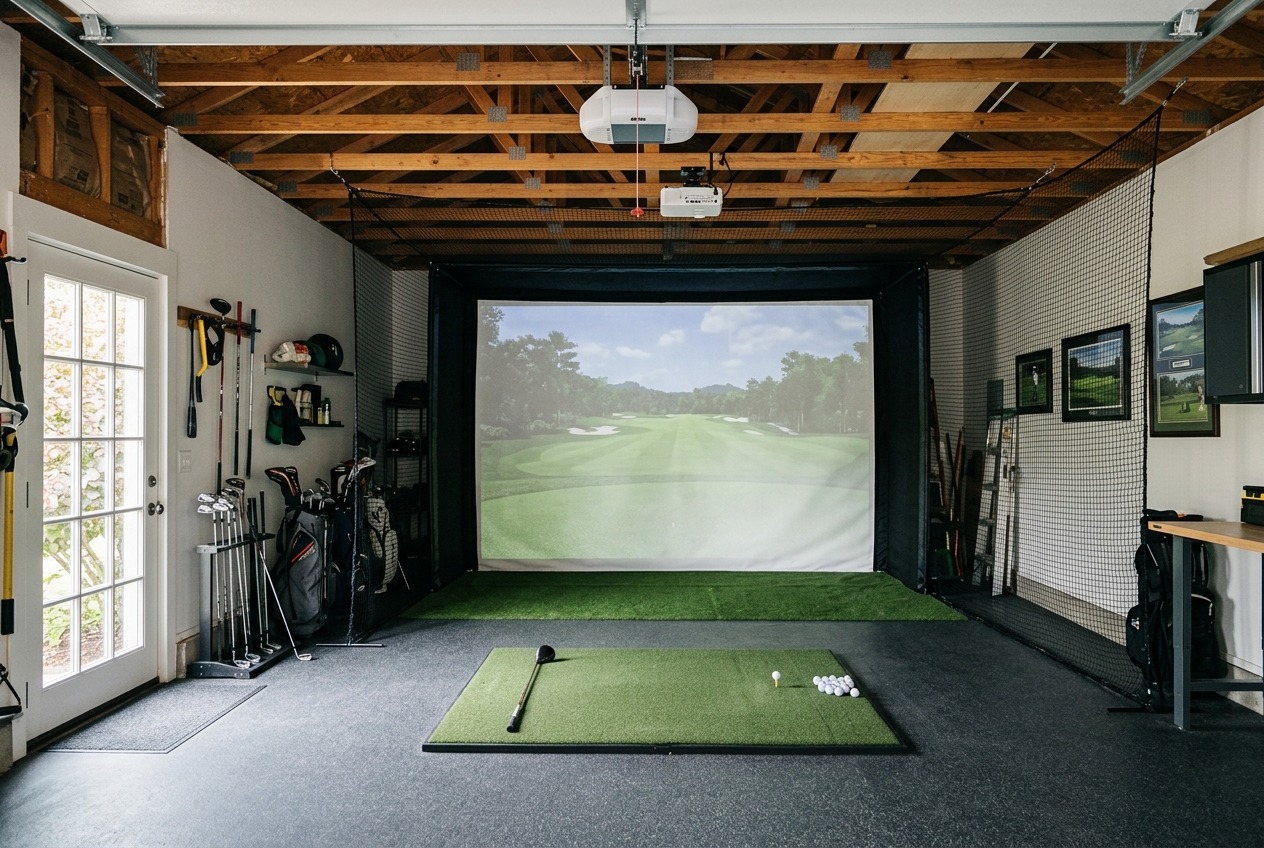
A home golf simulator can start around $2,500 to $4,000 for a capable DIY-style package. More complete systems commonly move into the $4,000 to $12,000 range, while premium integrated installations can run $15,000 to $45,000 or more. The reason the range is so wide is that a simulator is a system, not a device: a complete build includes a launch monitor, software or a subscription, a hitting mat, an impact screen or net, an enclosure or frame, a projector and mount, cabling, and frequently flooring, lighting changes and a computer or tablet. Homeowners who price only the launch monitor typically underestimate the project substantially.
Equipment and package pricing, not installed cost. Room work — flooring, lighting, electrical and any construction — sits outside these ranges. Ranges are guidance, not quotes. Verified 6 September 2026.
Already know your budget and your space?
Visitor understands every line item in a complete simulator build so they can set a realistic budget instead of pricing a launch monitor alone.
Why the number you saw is probably not the number
Search results usually quote a launch monitor price or a bundle price. Neither is the cost of a working simulator in a real room. The gap between those figures and the finished project is where most disappointment in this category comes from.
Every line item in a complete build
Use this as a quoting checklist. If a package omits an item, the item still exists.
- Launch monitor or ball-tracking device
- Simulation software and any recurring subscription
- Hitting mat — and a subfloor or platform if used
- Impact screen or net
- Enclosure or frame, plus side and ceiling protection
- Projector
- Projector mount and cabling (video, power, signal routing)
- Computer, tablet or console to run the software
- Lighting changes — most rooms need less light, not more
- Room work: insulation, climate control, electrical, wall protection
- Optional: seating, storage, club racks, sound
The four decisions that move the total most
Launch monitor technology
The largest single variable, and the one most tied to your room dimensions. Radar and camera-based units have different space requirements and different price structures.
Software model
One-time licence versus recurring subscription changes the multi-year cost significantly. Confirm what is included and what renews.
Enclosure versus net
A full enclosure protects the room and looks finished; a net is cheaper and less forgiving. This choice also affects screen size and projector geometry.
Room readiness
A finished, insulated room with power where you need it costs far less to convert than a bare garage. Room work is invisible in product comparisons and very visible in the final invoice.
Supporting questions
Can I build it in stages?
Yes, and it is common: launch monitor and net first, then screen and enclosure, then projector. Plan the room and mounting for the finished state so nothing has to be redone.
Is a projector required?
No. Many golfers run software on a large display or tablet. Projection is what makes it feel like a simulator rather than a practice net.
What are the ongoing costs?
Software subscriptions, occasional mat replacement, screen wear, and projector light-source replacement depending on the unit. Verify each per product.
Deeper details
Affiliate disclosure: some links on Human Home Living may be affiliate links, and we may earn a commission at no additional cost to you. That does not affect our conclusions. See our affiliate disclosure and editorial standards.