
Will a Golf Simulator Fit in My Garage?
Ceiling height decides this, not floor space. Here is how to measure your garage properly, which dimension is actually limiting you, and what changes when you can't get the height you want.
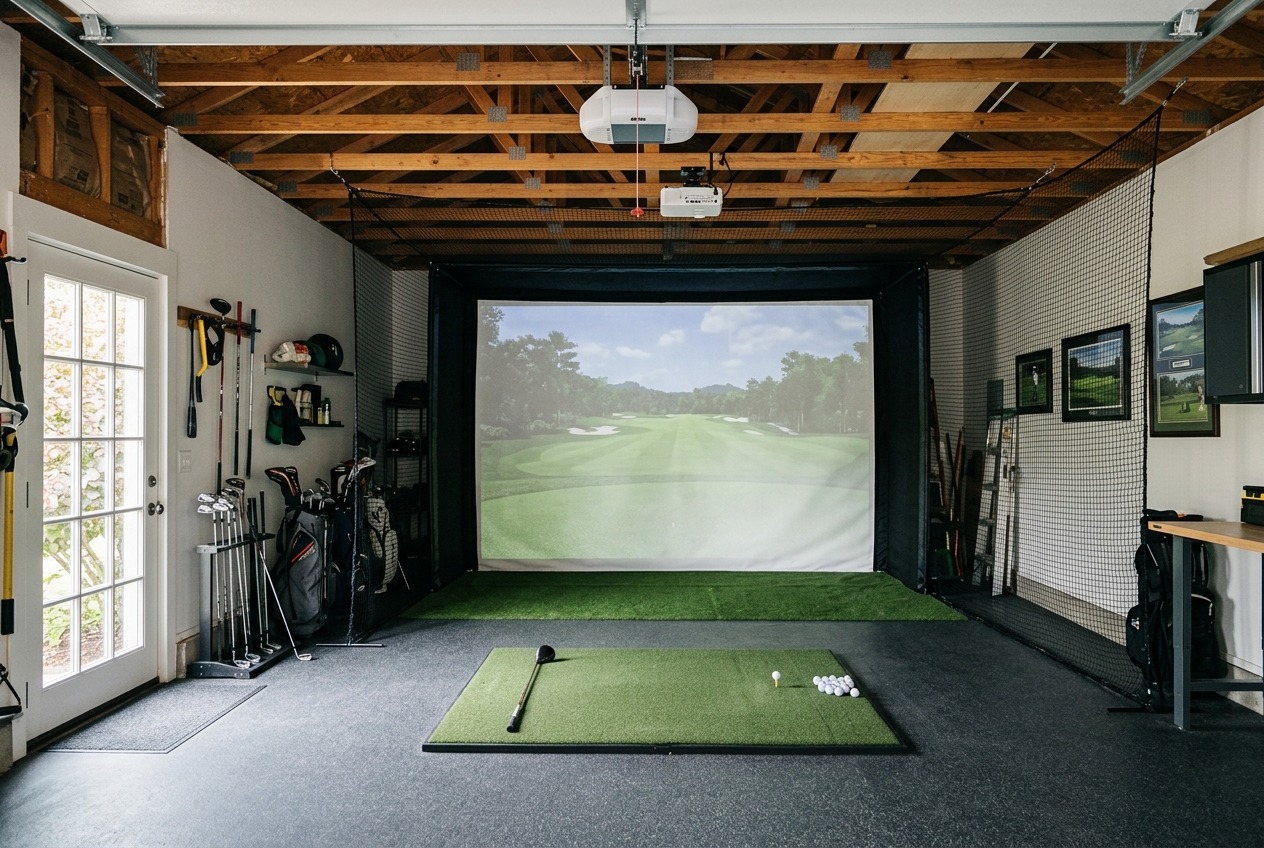
Most garages can hold a golf simulator — but ceiling height decides whether it will be a full-swing setup or a compromise. Height is the hard constraint, width matters more than length for a comfortable swing, and length only becomes critical if you are using a camera-based launch monitor that needs distance behind or in front of the ball. Measure ceiling height at its lowest point, including the garage door track and any opener, before you look at a single product page.
Already know your room dimensions?
Visitor determines whether their room dimensions support an appropriate simulator configuration, and which dimension is limiting them.
Why garages usually fail on height, not floor space
Homeowners tend to evaluate a simulator by floor plan: is there room for a mat, a screen and a hitting area? That is the wrong first question. A full golf swing is a vertical event. The club travels above your head at the top of the backswing and again through follow-through, and it does that in the same place every time — roughly above and slightly behind the ball.
Garages are also the most likely room in the house to have obstructions in exactly that zone: an overhead door track, a door opener motor, low-hanging joists, ductwork, lighting, or a garage door panel that swings up into the ceiling space. A garage with a nominal ceiling height can lose meaningful clearance to those items, and the number that matters is the lowest point in your swing zone, not the highest point in the room.
So the sequence is: measure the lowest clear height in the swing zone, then decide how much of a compromise you are willing to make, then look at systems.
Measure these five numbers before anything else
Write them down. Every product decision that follows depends on them, and every credible retailer or installer will ask for them.
Your five measurements
Take each measurement twice. A one-inch error on ceiling height changes the answer.
- Lowest clear ceiling height in the swing zone — measured with the garage door fully open, including the door track, opener and any light fixture.
- Room width, wall to wall, at the height where you will actually swing (not at floor level, where trim and shelving distort it).
- Room length from the screen wall to the back wall or the nearest obstruction behind you.
- Screen wall width — the usable flat span available for a screen or enclosure, minus outlets, panels, windows and door frames.
- Distance from the hitting position to the nearest side wall on your trail side (right side for a right-handed golfer).
The four dimensions and what each one actually controls
Ceiling height — controls whether you can swing at all
This is the pass/fail dimension. If you cannot complete a full swing safely, no other feature of the system matters. Options when height is short include raising the hitting position issue in reverse (a thinner mat rather than a thick platform), relocating or converting the garage door opener, or accepting a wedge-and-iron practice setup rather than a full-bag simulator.
Width — controls comfort and safety
Width determines whether both a right-handed and a left-handed golfer can use the space, whether you can stand square to the screen without shortening your swing near a wall, and whether the screen can be centered. If only one golfer uses the space and they are right-handed, you can often shift the hitting position toward one side and gain usable width.
Length — controls launch monitor choice
Length is usually the most flexible dimension, but it is the one that dictates which launch monitor technology will work. Radar-based units generally want space behind the ball; camera and photometric units generally want to be positioned near or above the ball with a specified distance to the screen. This is the most common place we see a homeowner buy the wrong device for their room.
Screen wall width — controls image size
Your usable flat wall span sets the maximum screen or impact-screen width, which in turn sets your image size and how much of the projected picture is usable. Panels, subpanels, hose bibs and window openings frequently reduce this span more than homeowners expect.
Questions homeowners ask next
Can I use a garage that isn't insulated or climate controlled?
Physically yes, and many homeowners do. But temperature and humidity swings affect electronics, screens, projector performance and, over time, mats and enclosure fabric. If the garage regularly reaches extremes, plan for insulation, a mini-split or seasonal use. Also confirm the operating temperature range published by the manufacturer for any launch monitor or projector you are considering.
Do I need a permanent installation?
No. Temporary or retractable setups exist specifically for shared garages: portable nets and screens, hitting mats that stow, and projectors on a shelf or a mobile stand. The trade-off is setup friction. If it takes fifteen minutes to set up, you will use it less. If the garage must still hold cars, prioritise a configuration you can deploy in under two minutes.
What about the concrete floor?
Concrete is unforgiving over long sessions, and a thin mat on concrete transfers impact into your joints. Thicker mats and subfloor systems reduce that, but every inch you add to the floor is an inch you remove from your ceiling clearance. This is the single most common trade-off in garage simulators.
Left-handed and right-handed in the same space?
This is a width question and a hitting-position question. Dual-handed use generally requires either a wider room or a hitting strip that allows the ball position to move laterally, plus a launch monitor placement that works from both sides. Confirm the dual-handed capability of a specific launch monitor before assuming it.
Will the projector fit if the ceiling is low?
Low ceilings push you toward short-throw projection and careful mounting so the golfer's head and club never enter the light path or the mount's swing zone. Throw ratio, lens shift and mount depth all have to be checked against your measured room. This is the same geometry problem covered in our projection guides.
What to do when the height simply isn't there
If your clear ceiling height cannot support a full driver swing, you still have three legitimate paths, and all of them are better than buying a system you will resent.
First, a short-game and iron practice setup. A smaller screen or net, a launch monitor that reports well on partial swings, and a realistic acceptance that you will not be hitting driver indoors. Many golfers get more handicap improvement out of this than out of full-swing practice anyway.
Second, relocate the project. Basements with open joists sometimes offer more clear height than a garage with a door track. An outbuilding or a portion of a barn or shop often offers the most.
Third, modify the space. Removing or relocating an overhead door opener, converting to a side-mount or jackshaft opener, or in some cases raising a ceiling section are all real projects with real costs — but they are the honest options, and a contractor can price them before you spend anything on golf equipment.
The decision, stated plainly
Measure your lowest clear height in the swing zone. If it supports your full swing, your remaining decisions are about width, launch monitor technology and projection geometry — all solvable. If it does not, decide between a scaled-down practice setup, a different room, or a construction change, and stop shopping until that is settled.
Deeper details
Affiliate disclosure: some links on Human Home Living may be affiliate links, and we may earn a commission at no additional cost to you. That does not affect our conclusions. See our affiliate disclosure and editorial standards.
Related decisions
How Much Does a Complete Golf Simulator Really Cost?
The launch monitor is one line item. Here is the complete list of what a working simulator actually requires — so you can budget the project, not the gadget.
Read the guide
OLED vs Projector: Which Is Better for My Room?
The honest answer depends on your windows, your seating distance and when you actually watch. Here is how to decide before you compare models.
Read the guide