
OLED vs Projector: Which Is Better for My Room?
The honest answer depends on your windows, your seating distance and when you actually watch. Here is how to decide before you compare models.
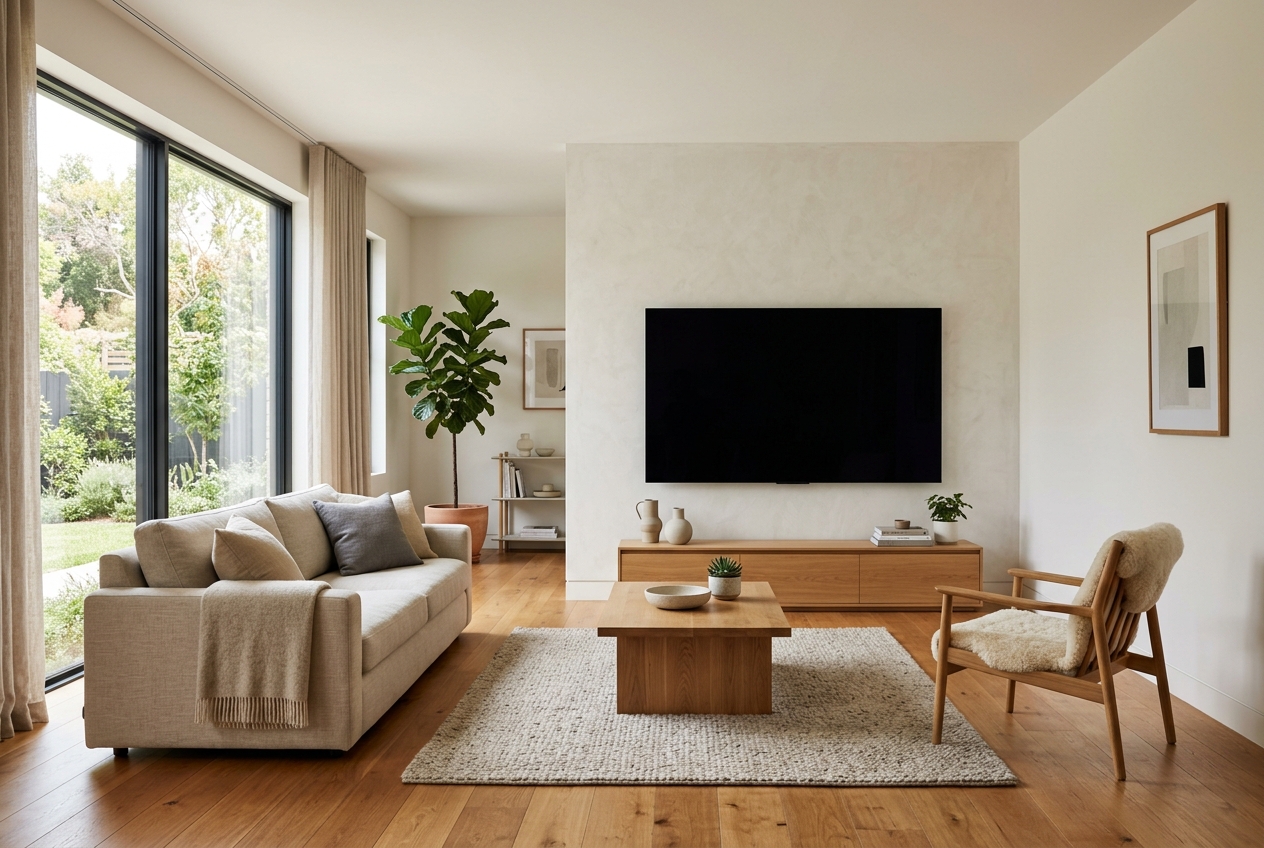
Light control decides this, not picture quality. If the room has significant daytime light you cannot block, a premium display will look better more of the time. If you can genuinely darken the room — or you are willing to install proper light-blocking shades — projection gives you an image size a television cannot match at the same cost. On budget, projectors span a very wide range: capable 4K models start around $1,000 to $3,000, premium home-theater projectors commonly run about $3,000 to $10,000, and high-end laser models can cost roughly $10,000 to $30,000 or more.
Projector price only. A screen, mount, cabling, light control and installation are separate and are a meaningful share of a projection budget. Ranges are guidance, not quotes. Verified 6 September 2026.
Already decided between a display and a projector?
Visitor determines whether their room's light control, geometry and usage pattern point toward a premium display or a projection system.
This is a room question wearing a product costume
Search results for this decision are dominated by model rankings. That is the wrong frame. A projector that reviews brilliantly can look poor in a bright living room, and a superb display can feel underwhelming in a dedicated dark room where you wanted a cinema-scale image.
So ask the room questions first: How much light enters, and can you control it? How far away do you sit? How wide is the wall you would put an image on? When do you actually watch — evenings, or all day? Answer those and the technology choice mostly makes itself.
The five room factors that decide it
Ambient light, and whether you can control it
A self-emissive display produces its own light and holds up in a bright room. A projector reflects light off a screen, so ambient light directly reduces contrast. The critical distinction is not 'is the room bright' but 'can I make it dark when I want to'. Blackout or light-blocking shades change this answer completely — and they are a legitimate part of a projection budget rather than an afterthought.
Image size versus seating distance
Bigger is not automatically better. Sitting too close to a very large image makes you scan rather than watch, and it exposes source-material limitations. Work from your seating distance to a comfortable image size, then check whether a television is available at that size or whether projection is the only realistic route.
Room geometry and throw
Projection adds a geometry problem a television does not have: the projector must sit at a distance and height that produces your target image size on your screen wall, using its throw ratio, optical zoom and lens shift. Whether that is a long-throw unit on the ceiling, a short-throw unit, or an ultra-short-throw unit on a cabinet depends entirely on your room's dimensions and where you can run power and signal.
What you watch
Daytime sports and broadcast television are the strongest argument for a display. Evening films are the strongest argument for projection. Gaming depends on the specific unit's input latency, which must be checked per model rather than assumed by technology.
Equipment visibility and installation tolerance
A ceiling-mounted projector with hidden cabling is the cleanest projection result and the most involved installation. An ultra-short-throw unit sits on furniture near the wall and needs no ceiling work, but it occupies the space in front of the screen and is far more sensitive to screen type. Decide how much installation you are willing to do before you choose the projector class.
Objections and supporting questions
Can't a bright projector just overcome my windows?
Brightness helps, and ambient-light-rejecting screens help considerably more than most homeowners expect. But a projector in a sunlit room is still fighting physics — you are adding light to a surface that already has light on it. Higher brightness plus an ALR or CLR screen appropriate to your projector type is the real answer, and screen and projector type must be matched. An ALR screen designed for a long-throw projector is not the same as a CLR screen designed for ultra-short-throw.
Is a projector cheaper than a very large television?
At large image sizes, projection is usually the more accessible route to scale. But a projection system is a system: projector, screen, mount, cabling, light control and often audio. Compare the complete project against the complete display alternative, not projector price against television price.
What about lamp or light-source life and running cost?
Light-source type and rated life vary substantially between projectors, and replacement cost varies with it. This is a specification to verify per model — including the rated hours and what replacement involves — before you commit.
Do I need a special screen, or will a white wall do?
A wall works, and it is a reasonable way to test the concept. A proper screen gives you a controlled surface, correct gain, defined edges and better uniformity. If you are spending real money on the projector, the screen is not the place to save.
Which is better for gaming?
Input latency and refresh support are model-level specifications, not technology-level ones. Some projectors are excellent for gaming and some are not; the same is true of displays. If gaming is a priority, treat measured input lag as a hard requirement and verify it for the specific model.
A quick way to see which direction your room points
| Your situation | Likely direction |
|---|---|
| Bright room, used all day, cannot add shades | Premium display |
| Mixed-use living room, shades possible, evening viewing matters | Projection with light control, or both in different rooms |
| Dedicated room or basement that can go fully dark | Projection |
| Want the largest possible image for the budget | Projection |
| Want zero installation and the simplest result | Premium display |
| Sports and broadcast television are the main use | Premium display |
Directional guidance only. Confirm image size against seating distance and, for projection, confirm throw geometry against your room.
Deeper details
Affiliate disclosure: some links on Human Home Living may be affiliate links, and we may earn a commission at no additional cost to you. That does not affect our conclusions. See our affiliate disclosure and editorial standards.
Related decisions
77" vs 83" vs 97" OLED: Where Does the Price Stop Making Sense?
Each size step costs more than the last. Here is how to tell which step your room actually justifies — and where the money stops buying experience.
Read the guide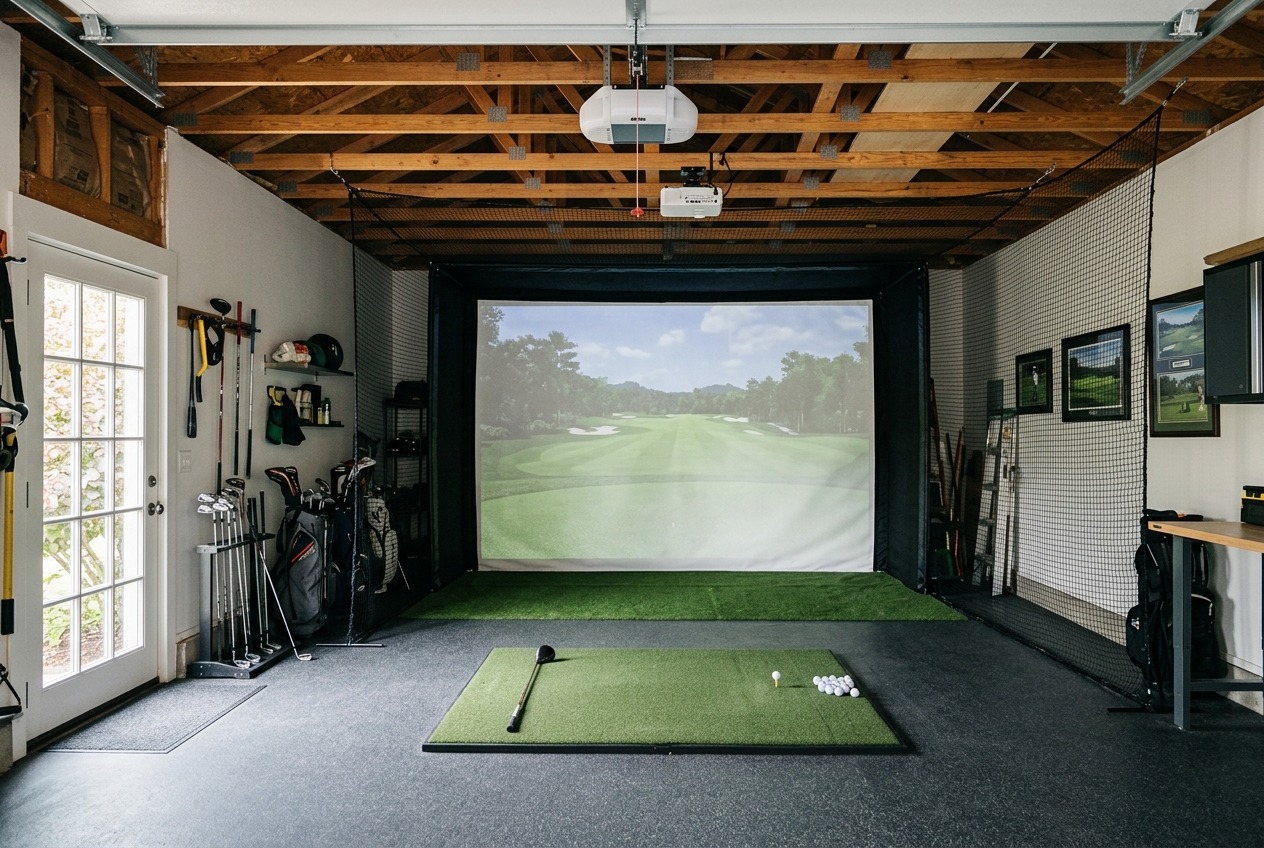
Will a Golf Simulator Fit in My Garage?
Ceiling height decides this, not floor space. Here is how to measure your garage properly, which dimension is actually limiting you, and what changes when you can't get the height you want.
Read the guide